The World Health Organization delivered a stark warning in November 2026: a quarter of teenagers globally engage in basically no physical activity — not even an hour of exercise a week. The finding, reported from Geneva, is not about elite sport or gym memberships. It is about movement itself: walking, playing, cycling, dancing, anything that raises the heart rate. For one in four teenagers, that has effectively stopped. The WHO warns that this significantly raises health risks, and the consequences will not arrive all at once. They will accumulate quietly, over decades, in the form of weaker bones, poorer heart health and worse mental health.
It is tempting to blame teenagers themselves, or their phones. The truth is more complicated, and more fixable. Many teenagers live in places where safe outdoor space has disappeared — streets built for cars rather than people, parks that close early or feel unsafe, and schools that have cut physical education to make room for exam preparation. Screens fill the gap because they are available, social and free. A teenager who wants to play football needs friends, a pitch and permission. A teenager who wants to watch videos needs only a phone. When the easy option and the healthy option point in opposite directions, most people — adults included — take the easy one.
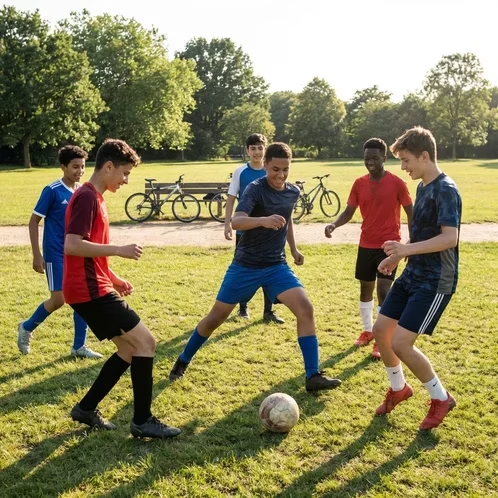
Schools are part of the problem, but they are also the most powerful part of the solution. A school day is the one place where almost every teenager can be reached, regardless of family income. Daily movement does not require expensive facilities: walking meetings, active breaks between lessons, dance, martial arts, or simply protecting break time from being swallowed by extra classes. Countries that treat physical activity as a core subject, not a reward for finishing real work, tend to get better results — not only in fitness, but in concentration and behaviour. A body that has moved learns better than a body that has sat still for six hours.
Parents and communities matter too, and the most effective changes are often the smallest. Walking or cycling to school instead of driving, when it is safe to do so. One screen-free evening a week, replaced by a family walk or a game. A teenager who finds one physical activity they actually enjoy — skateboarding, swimming, climbing, dancing — is far more likely to keep moving than one who is forced into a sport they hate. The goal is not to produce athletes. It is to protect the habit of movement before it is lost, because habits formed in adolescence tend to last a lifetime, in both directions.
The WHO’s warning should be read as good news in disguise: this is a solvable problem. No new drug is needed, no breakthrough required. What is needed is a decision, repeated by schools, cities and families, that teenagers’ bodies matter as much as their exam results. A generation that barely moves will pay for it in middle age, in hospital visits and lost years of healthy life. A generation that moves — even a little, even imperfectly, even just an hour a week to start — will carry that strength forward. The cheapest health policy in the world is a teenager running, playing and laughing outdoors. We just have to make room for it.
Sources: WHO warning on teenage physical inactivity, reported November 2026 (via Philippines Climate Change Commission news roundup, 6 November 2026).